


“The Cave You Fear to Enter Holds the Treasure You Seek” – Joseph Campbell.
Ajanta and Ellora Caves: A UNESCO World Heritage Masterpiece
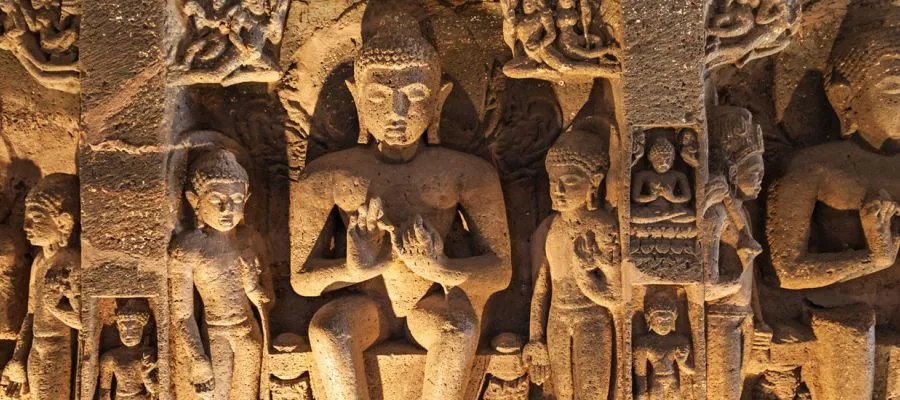
Ajanta and Ellora Caves are among India’s most extraordinary UNESCO World Heritage Sites, showcasing centuries of artistic brilliance and spiritual devotion. Nestled in Maharashtra, these ancient rock-cut caves embody the vibrant heritage of Buddhist, Hindu, and Jain traditions.
Ajanta is renowned for its breathtaking murals and sculptures that beautifully depict the life of Buddha, while Ellora captivates visitors with its magnificent temples, monasteries, and the famous Kailasa Temple, which is carved from a single piece of rock. These caves are not merely architectural wonders; they are also living testaments to India’s cultural and religious unity.
Exploring Ajanta and Ellora is like embarking on a captivating journey through India’s ancient history, art, and craftsmanship, making them a must-visit destination for heritage lovers and history enthusiasts.
10 Famous Hollywood Movies Shot in India | The Film Tour of India
History is often Half Mystery!
The Sleeping Buddha, Ajanta Caves
From the Edakkal Caves in Kerala with neolithic petroglyphs to the holy Badami Cave Temple in Karnataka, every cave in India has its own surreptitious tale to enthral the historians, painters, sculptors, and architects of the world. But no cave in the world came close to the legacy of the Ajantha and Ellora sisters resting for thousands of years near the once Mughal territory, Aurangabad (The city was named after the infamous Aurangzeb) Many catastrophic injustices had occurred to the 29 caves in Ajanta and 34 caves in Ellora (The Divine-sculpted Kailasa is one among them) but none could completely destroy the murals, art, and soul of the caves.
8 Popular Sweets of India with Recipe Links| The Food Tour of India
The Surreal Heritage Corner
Ajanta Caves – The Rock-Cut Buddhist Temples
Close to the trekkable Daulatabad Fort near Aurangabad in Maharashtra, the horse-shoe shaped Ajanta Caves built and updated constantly from the 2nd century BC to 6th century AD is just at a distance of 100 km from Ellora. While the oldest is Ajanta, “Verul-Leni” or Ellora is near to Aurangzeb’s wife’s mausoleum, “Bibi Ka Maqbara” (Dakkhani Taj) and Grishneshwar Temple built out of the red rock for the powerful Lord Shiva is an inevitable Shaivite pilgrimage site. Islam and Hinduism encircle the cave making it a true Unity in Diversity destination, both inside and outside the human-made marvel. It is clearly a UNESCO World Heritage Site and also requires the maximum attention from tourists, architects, restorers, photographers, Indians, and foreigners to approach this heritage in a responsible manner.
Do Jyotirlinga Temples Follow Lord Shiva’s Conch-Shaped Fibonacci Pattern?
“The Tomb of the Lady”
Michelangelo once commented, “Work of Angels” looking at the Parthenon in Athens, Greece. The artist would have stayed forever in India to find how the Rock-cut Kailasa Temple had happened which is sure “Work of the Creator of Angels”. Double the size of Parthenon, the Caves in Ajantha are completely draped in Buddhism while Ellora is a blend of Hinduism (17 caves), Buddhism (12 caves), and Jainism (5 caves). We’ll see the must-visit caves lists with exact cave numbers, later.
Ellora Caves – The Union of Buddhism, Hinduism, and Jainism
“You don’t let a historic site rot.” – Robert Ballard
This quote is essentially the heart of this write-up. To preserve and give the right amount of respect for a noteworthy place that takes in more than 4,000 visitors per day. The number must be cut into half since human breathing near the paintings are lethal as carbonization tampers the original inscriptions, storylines, and carved pillars. All the Earth colours, vegetable colours, Banyon bark, sawdust, hibiscus cannabis, horse manure, cow dung, and minerals used in an intelligent way to convey anecdotes, everyday scenes, and historically unforgettable happenings should not be erased just for the sake of puny bribes given at the entrance of these precious caves. Like mentioned before, people surrounding this area, employed or unemployed, Indian or foreigner must take care of the cave’s creative carvings.
The 8 Mysterious and Interesting Temples to Visit in India | The Strangest Temples of India (Part 1)
Ellora Caves – The Union of Buddhism, Hinduism, and Jainism
“You don’t let a historic site rot.” – Robert Ballard
This quote is essentially the heart of this write-up. To preserve and give the right amount of respect for a noteworthy place that takes in more than 4,000 visitors per day. The number must be cut into half since human breathing near the paintings are lethal as carbonization tampers the original inscriptions, storylines, and carved pillars. All the Earth colours, vegetable colours, Banyon bark, sawdust, hibiscus cannabis, horse manure, cow dung, and minerals used in an intelligent way to convey anecdotes, everyday scenes, and historically unforgettable happenings should not be erased just for the sake of puny bribes given at the entrance of these precious caves. Like mentioned before, people surrounding this area, employed or unemployed, Indian or foreigner must take care of the cave’s creative carvings.
The 8 Mysterious and Interesting Temples to Visit in India | the Strangest Temples of India (Part 1)
Where Are Ajanta and Ellora Caves Located and How to Reach
The Ajanta and Ellora Caves are nestled in Maharashtra, not far from the city of Aurangabad, which is now known as Chhatrapati Sambhajinagar. Ajanta is approximately 100 kilometres away from the city, while Ellora is just 30 kilometres away, making Aurangabad an ideal starting point for travelers.
The closest airport is Aurangabad Airport, which offers regular flights from major Indian cities like Mumbai, Delhi, and Hyderabad. Plus, Aurangabad is well-connected by train and road, with frequent services from Mumbai, Pune, and other regions of India.
From the city, tourists can easily hire taxis, rent private cars, or hop on state-run buses to reach both cave complexes. The roads are clearly marked, and there are plenty of visitor facilities, ensuring a smooth journey for both domestic and international travelers.
Religious Significance of Ajanta and Ellora Caves
Ajanta and Ellora Caves hold immense religious importance as they represent three major Indian faiths—Buddhism, Hinduism, and Jainism—coexisting in harmony. Ajanta is mainly known for its Buddhist heritage, featuring monasteries and prayer halls that are beautifully decorated with paintings illustrating the life and teachings of Lord Buddha. These caves served as centres for meditation, learning, and monastic life for centuries. In contrast, Ellora presents a fascinating mix of Buddhist, Hindu, and Jain caves, highlighting India’s rich tradition of religious tolerance.
The stunning Kailasa Temple at Ellora, dedicated to Lord Shiva, stands out as a remarkable example of Hindu devotion and the artistry of rock-cut architecture. Together, these caves embody India’s spiritual diversity and its deep cultural unity.
Preservation Challenges and Restoration Efforts at Ajanta and Ellora
When it comes to preserving the Ajanta and Ellora Caves, the challenges are significant due to natural aging, weather conditions, humidity, and the effects of tourism. The ancient paintings and sculptures are particularly susceptible to moisture, fungal growth, and pollution, which can lead to fading and structural damage. Human activities, like touching the murals, graffiti, and overcrowding, also pose serious risks.
To address these issues, the Archaeological Survey of India (ASI) and UNESCO have implemented conservation measures, including controlled visitor access, climate monitoring, and scientific restoration techniques.
Protective coatings, enhanced drainage systems, and awareness programs are all part of the effort to safeguard these heritage sites. Ongoing research and sustainable tourism practices are crucial to ensure that these incredible masterpieces are preserved for future generations.
The Finely Cut Pillars, Arches, and Ceilings of Ajanta Caves
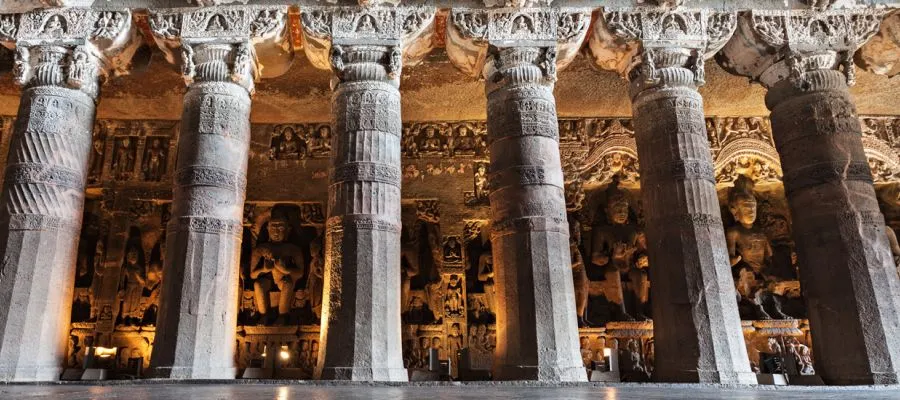
Restoration Mistakes – The Dawn is Not So Far
The Architectural Survey of India (ASI) is really doing their best to restore the lost glory of the deteriorating paintings. Still, some zealous restorers combined with their poor varnish removal techniques have made notable damages to the paintings. Not only now, during the reign of the Nizams, the use of a distinct varnish, and “shellac” by a renowned Italian expert L. Cecconi had also invited misery to the ineffable illustrations. The eroded surfaces of the deforested hills have contributed to the unwanted dust accumulation and ultra-violet rays have ruined some portions too. Soon, the Archaeological Survey of India will interfere and enhance the look and feel.
Why you should visit the 1000 year old Big Temple in Tamilnadu?
“Ruins for me are the beginning. With the debris, you can construct new ideas. They are symbols of a beginning.” – Anselm Kiefer
Visitor Guidelines and Photography Rules at Ajanta and Ellora
Visitors to Ajanta and Ellora Caves are advised to follow strict guidelines to protect these ancient heritage sites. Touching paintings and sculptures is prohibited, as oils and moisture from hands can damage fragile surfaces. To protect the ancient artworks, smoking is not allowed inside the caves. Photography is welcome in most sections, allowing you to capture memorable moments; however, please avoid using flash, especially at Ajanta, as it can damage the delicate murals. If you plan to use tripods or professional equipment, kindly obtain prior permission from the authorities to ensure a smooth and responsible visit.
Visitors should stay on marked pathways, respect signage, and follow instructions from site staff to help preserve these UNESCO-listed monuments for future generations.
The Planet Focuses on Responsible Tourism
Paintings like the Black Princess and Apsaras are under a constant threat as more hours of spent by tourists standing close to it. Responsible tourism can only solve this issue along with intuitive and logical actions of the ASI. Luckily, the cave’s location saves it from constant nudging but from November to March, dance and music festivals stuff the premises. To save a monument, rules aren’t enough, responsibility is important to increase the life of a heritage site thereby conducting it to the future generations.
Top 5 Obvious Benefits of Travelling | Learn Why Travel Makes You a Better Person
The gradual decay of the bonding element used in murals have come off as chunks and some paintings have even become chalky. Silverfish, a tiny insect is suspected to have eaten portions of the paintings. Biodegradation and Bat Excreta have played their role in destroying the monument’s signature works. Mass fumigation is a must to preserve the work of the alien-alike genius humans of the past.
Note: Flash photography is forbidden inside the caves. (As you know some places are beyond beautiful to be just photographed.)
Best Time to Visit Ajanta and Ellora Caves
The ideal time to explore the Ajanta and Ellora Caves is between October and March. During these months, the weather is just right for wandering through the stunning cave complexes. The winter months bring comfortable temperatures, making it perfect for strolling around and admiring the detailed murals and sculptures. The monsoon season, from June to September, transforms the landscape into a lush, vibrant paradise. However, the frequent rains can make pathways slippery and travel slightly challenging for visitors. Summers can get scorching, especially at Ajanta, so if you do visit during this time, early morning is your best bet. All in all, winter is widely regarded as the most pleasant and visitor-friendly season.
Human Stories behind the Ajanta and Ellora Legacy
Beneath the impressive facade of Ajanta and Ellora lies the unwavering commitment of countless monks, artisans, and patrons who have contributed to these incredible works over the centuries. At Ajanta, Buddhist monks turned the caves into monasteries, dedicating their lives to meditation, teaching, and safeguarding sacred texts.
Talented craftsmen meticulously carved stunning sculptures and painted vibrant murals using natural pigments, often in low-light conditions. Meanwhile, at Ellora, Hindu, Buddhist, and Jain communities thrived side by side, each leaving its spiritual mark on the rock.
Kings and wealthy patrons funded these projects as acts of devotion and cultural pride, creating a timeless legacy of faith, art, and human perseverance.
Prasad Powar and his Contribution to the Ajanta Caves
“It is good people who make good places.” – Anna Sewell
Captain John Smith in 1819 had been into vandalism inside the caves knowingly or unknowingly. After incidents like these, the amount of restoration couldn’t save the amount of vandalism that had happened. Would you believe if a photographer had dedicated 27 years to digitally restore the paintings of the Ajanta Caves?
Meet Mr Prasad Powar (50) who has travelled to China and Sri Lanka to study the elements used in the painting and works with the sun. What? Yes, under the poor light conditions where highly emitting artificial lights are not allowed, Prasad Powar is making use of the sun’s natural beam falling inside the caves to digitally restore the lost statuesque of paintings like the famous Padmapani.
He has studied Pali, Marathi, Sinhalese, and Tamil literature just to understand the characters, their depths, and positioning significance to fix the missing parts of the storylines present inside the caves. He has been once honoured by the Buddhist sage, Dalai Lama and his IGNCA exhibitions about Ajanta caves is a dream come true mission. The intricate artworks cannot be refurbished as it is done for a dilapidated bungalow, the must-read storyline and intense emotions of the characters have a lot to share with the world and people like Prasad Powar are keeping its hopes alive.
5 Cleanest and Beautiful Beaches in Goa | the Coastal Tour of India
His photographic documentation has covered 14,400 sq.m of the Ajanta Caves. He often wonders how our ancestors painted such a marvel in low light conditions whereas our technological world is no match for their hammers and chisels. The artist turned photographer isn’t looking for monetary aid from the government sooner or later. More people like him interested in saving the deteriorating monuments of India should come forward. While constant monetary help should be rendered by the Indian government for taking cultural tourism to the next level.
10 Life Lessons from Travelling | Learn Why Travel Makes You a Better Person – Part 2
Strange Events or Warnings?
- Attempts to facsimile the beautiful murals of Ajanta by the East India Company in 1866 failed due to an untimely fire accident which burnt the work of 2 decades.
- In 1872, a principal from Mumbai had tried to do the same but the strange fire accident has once again burnt his works.
The 8 Mysterious and Interesting Temples to Visit in India | the Strangest Temples of India (Part 2)
Exploring the Caves: Ajanta and Ellora in Detail
The Ajanta and Ellora Caves provide a captivating look into the ancient rock-cut architecture and artistic brilliance of India. Ajanta is home to 30 Buddhist caves, which include prayer halls (chaityas) and monasteries (viharas) beautifully decorated with stunning murals, sculptures, and carvings that tell Buddhist stories and depict everyday life. On the other hand, Ellora boasts 34 caves that represent Buddhist, Hindu, and Jain traditions, with the magnificent Kailasa Temple standing out as a true highlight. Each cave offers its own unique architectural style, intricate carvings, and spiritual themes. Exploring these caves provides visitors with the opportunity to observe centuries of craftsmanship, religious devotion, and cultural evolution intricately carved into solid volcanic rock.
Cave by Cave – Ajanta
Catch the terraced pathway and enter the caves. Don’t miss the panoramic view from the “viewing platform”. You are inside a gifted monument that had been dedicated to Theravada and Mahayana Buddhism. Here are the must-visit caves with their numbers.
- Cave 26: It is a melancholic Chaitya (a discussion arena of the past) with the reclining Buddha, in the verge of death with mourning disciples.
- Cave 17: Celestial figures on the ceiling – musicians, guardians of the door, Apsaras, Nymph, and Ogresses.
- Cave 16: Sundari, a fainting princess is a major attraction.
- Cave 15, 13, 12: Theravada monastery caves
- Cave 10: The oldest in Ajanta (prayer hall of Theravada)
- Cave 9: An architectural brilliance (prayer hall) with arched windows for allowing sunlight to naturally light up the caves.
- Cave 8: A detailed monastery.
- Cave 4: Incomplete cave still the largest.
- Cave 2: Adorned ceilings with fictional creatures – demons, flowers, fruits, and other celestial objects.
- Cave 1: The most popular cave with Vajrapani holding the thunderbolt on the right and Padmapani on the left holding the water lily.
How did Marottichal become the Chess Village of India? | The Healthy Addiction Story
The sanctum here is full of Jataka Tales and outside the caves, a sick man, an old man, and a corpse are in the form of friezes to depict the life-changing moment of Buddha.
Cave by Cave – Ellora
Dating from the 600-1000 CE, staying close to the Jalgaon Station, Ellora is a blend of Buddhism, Hinduism, and Jainism developed in the respective order. So, what are the must-visit caves?
- Cave 1-12: Belongs to Buddhism
- Cave 5: Maharwada Cave (The Mahar tribe’s shelter during the monsoon)
- Cave 6: Developed early in the 600’s, it has the intense and powerful Goddess Tara on the left and the Buddhist Goddess of Learning – Mahamayuri on the right
- Cave 11: Dho Tal (Two floors cave)
- Cave 12: Tin Tal (Three floors cave)
- Cave 13 to 29: Belongs to Hinduism
- Cave 14: Seven beautiful women with babies on their laps (Sapta Matrikas)
- Cave 16: THE KAILASA TEMPLE (A separate para below!)
- Cave 21: The oldest cave (Rameshwara) with sculptures of adorable couples, river goddesses, and two-door guardians.
- Cave 25: Sun god sculpture (He is riding toward dawn!)
- Cave 29: Dhumar Lena (Admire the playful, angry, and other unknown shades of Lord Shiva)
- Cave 30-34: Belongs to the Jainism
- Cave 32: Indhra Sabha (a miniature of Kailash Temple), Naked Gomateshwara, lotus flower ceiling, and vines clasping and spreading all over the meditating Jain god.
5 Must-Visit Forts of Rajasthan | the Desert Tour of India – Part 1
Kailasa Temple – The World’s Largest Man-Made Monolithic Temple
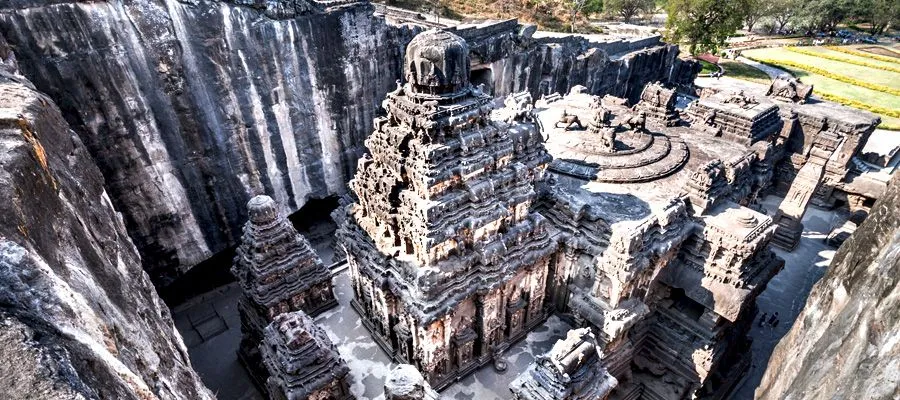
By removing a whopping 200,000 tonnes (400,000 according to many) of rock, ancient sculptors of modern India had written their supremacy all over the Kailash Temple which is much more complicated and challenging than the Stonehenge and Pyramids of Egypt. While there is countless fiction related to this temple that it has been built in a single week which is humanly impossible, there are alien and humanoid theories too. To our greater surprise, there is the sculpture of Ravana and his “Pushpak Vimana” (modern-day Jet Pack). Its design is close to today’s technological flying machines. How would have they managed to think of sculpting such a structure when the world was still proud of its wheels? Millions of ciphered Sanskrit texts, everyday scenes, scenes from Mahabharata and Ramayana, and tiny but detailed carvings, life-size elephants, a Nandi facing Lord Shiva are all made from constant mindful chiselling that had happened over a period of 20 years according to historians and expert architects of the world.
Five Popular Traditional Markets to Visit in India | the Experiential Tour of India
The dedicated workmanship in the western Indian provinces of Maharashtra hundreds of decades before was believed to be backed up and constructed by Krishna I of the Rashtrakuta Empire. The Chandranandri hills carved from the top to bottom with the basic set of tools is impossible to build even in today’s world. Have you heard of the 10 Avatars of Lord Vishnu? Witness their prowess in the South-eastern gallery of this temple.
Aurangzeb managed to destroy countless temples during the Mughal Era failed when his 1000 plus workers couldn’t deconstruct the Kailasa Temple. They could only disfigure some figures and statues. After years of trying, Aurangzeb gave up. Like he has surrendered to the mighty Lord Shiva.
Is Lord Shiva an alien? Is Ravana a humanoid? Were “Outsiders” helping human beings during the construction? We really don’t know. We’ll leave those things for you, travellers to study and analyse in-depth. Many have experienced mental clarity and improved physical health after visiting this temple and some other chaityas, stupas, and monasteries of these caves.
10 Delicious Indian Dishes for the True Foodie | the Food Tour of India
Inhale the positive vibrations in Ajanta and Ellora and shop handicrafts, ornaments, sculptures, and paintings before you fly or ride back home.
Get ready to experience ethereal happenings!
“The job of the artist is to deepen the mystery.” – Francis Bacon
Why Ajanta and Ellora Caves Still Fascinate the World Today
The Ajanta and Ellora Caves continue to captivate people around the globe with their incredible mix of art, architecture, and spirituality. These rock-cut monuments reveal how ancient civilizations mastered engineering, painting, and sculpture without modern tools. The stunning murals at Ajanta and the grand Kailasa Temple at Ellora highlight the peak of human creativity. Scholars, historians, and travelers are irresistibly drawn to their rich history, religious unity, and timeless allure. As UNESCO World Heritage Sites, they embody India’s vibrant cultural heritage and evoke global admiration for the ancient craftsmanship and artistic expression that have endured for over a thousand years.
Plan Your Ajanta and Ellora Heritage Tour with Indian Panorama
When you plan a heritage tour to Ajanta and Ellora with Indian Panorama, you’re guaranteed a smooth and enriching travel experience. From carefully crafted itineraries and knowledgeable guides to cosy accommodations and reliable transport, every aspect is meticulously organized. Whether you’re a history buff, a cultural explorer, or a photography enthusiast, Indian Panorama provides tailored tour packages to match your interests.
Recognized as a best tour operator, we also offer dependable car rental services across India, ensuring seamless connectivity and comfort throughout your journey.
Discover these iconic UNESCO World Heritage Sites with detailed insights, stress-free logistics, and personalized service, making your journey into India’s ancient past truly unforgettable and immersive.
Explore the Surreptitious cavernous corridors of Ajanta and Ellora Caves with Indian Panorama.
Mail: enquiries@indianpanorama.in
Phone: +91 431 4226122
For more details and bookings, feel free to visit, www.indianpanorama.in and get a free quote for your tour itineraries.