




No.4, Annai Avenue, Vasanth Nagar EXTN,
Srirangam, Trichy, Tamil Nadu ,620006.
CIN: U31100TN2010PTC078389
DUNS Number: 859496557

If deciphering is an art of the western world then encryption is a powerful sorcery of the eastern world. Especially, India remains as a mystery to geologists, archaeologists, paleontologists, historians, and mathematicians. What we going to decode or tell in detail is related to an ineffable mathematical phenomenon. The Fibonacci Series or Fibonacci Pattern. The same genius mathematical pattern popularized by the Renaissance artist of Italy. Most of us know about his all time beauty “Mona Lisa”, currently in Musee du Louvre or the Louvre Museum in Paris since 1797. But only a certain amount of the global population are familiar with “Vitruvian Man”, the geometrical brilliance.
The Oldest Language and Lap of the World – Tamil Part 1
Those who have read the Da Vinci Code by Dan Brown would have already started fantasizing about Professor Robert Langdon cracking the anagram –
O, Draconian devil! – Leonardo Da Vinci
Oh, lame saint! – Mona Lisa
but you would have not really memorized the displaced numbers of the Fibonacci Series -> 13 – 3 – 2 – 21 – 1 – 1 – 8 – 5
For those who are still curious about knowing What a Fibonacci Sequence is? Fibonacci sequence is that each number after the second 1 is equal to the sum of the two previous numbers. So 1+1 = 2, 1+2 = 3, 2+3 = 5, 3+5 = 8, 5+8 =13, 8+13 = 21 and so on.
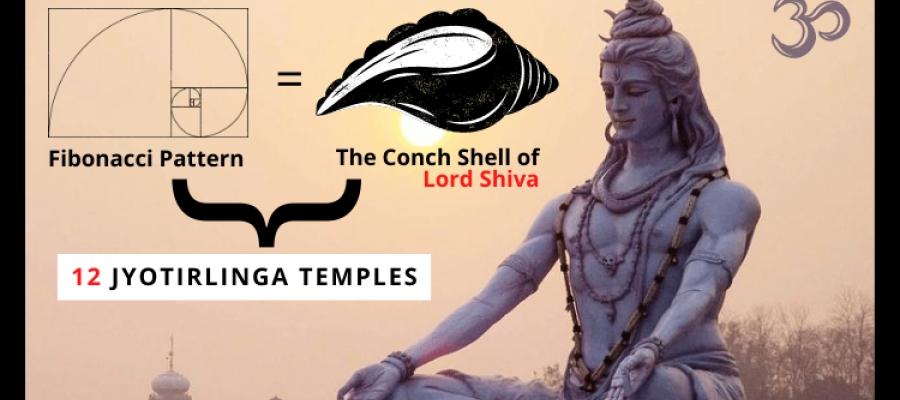
Jyotirlinga temples in India are not just spiritual hubs, they also seem to reflect the language of mathematics. When one plot their geographical locations, a captivating pattern appears—many of these spiritual sites synchronize in a spiral evocative of the Fibonacci sequence. This spiral, often viewed in shells, flowers, and cosmic systems, may signal at an ancient understanding of universal order by the sages who found these 12 Jyotirlinga temples. The alignment recommends that spirituality and mathematics were interconnected with the natural rhythm of the universe reflected in the placement of these sacred shrines.
The sequential spiral shapes of these 12 temples are shaped like the Conch Shell of Lord Shiva. The nature’s secret code is hidden in this growing Fibonacci pattern. Take a look at the picture below.
This interesting connection is only a mystery for human beings but not for Nature. This is known as the divine proportion and is usually represented by the Greek Letter φ (pronounced as ‘fie’). A few believe that the Parthenon in Greece is said to have been built keeping this golden ratio or divine proportion in mind. But accurate readings deny this made up theory. But what about Jyotirlinga Temples of Lord Shiva? Do they follow a Fibonacci pattern or the so called divine proportion?
The Oldest Language and Lap of the World – Tamil Part 2
Yes! Lord Shiva Temples built in the ancient times follow the laws of Nature and this time it is the Fibonacci Pattern. It is believed that he had appeared as a column of fire/light in these 12 places. Similarly all the five holy Lord Shiva Temples starting from Kedarnath to Rameshwaram are built on the same longitude of 79° E 41’54”, another mathematical beauty which we will discuss in a separate blog. Coming back to Jyotirlinga Temples backing up the Golden Ratio of 1.618, this geometrical magic is often used by Greek architects, famous painters like Da Vanci and Michael Angelo.
Madurai and Pandyan Kingdom and Lemuria
The dream physique for many, in fact Ian Fleming’s James Bond has also flaunted a similar physique in the movie Casino Royale released in 2006. Such following for achieving that golden ratio is also anticipated among women actresses like Scarlett Johansson. The Divine Proportion is always an honor to have around.
Leh Ladakh – The Mesmerizing Beauty of Nature
10 Cleanest and Beautiful Beaches in India
The Houseboats of Kashmir | The Houseboats of Kerala
Where to travel other than Goa for celebrating New Year 2021?
Mysteries of Puri Jagannath Temple in Odisha
Mysteries of Ajanta and Ellora Caves – The UNESCO Monuments
Science behind the Cosmic Dance of Lord Shiva
Most of the ancient sites in the world in Egypt, Peru, India, and countries with some of the advanced cultures have monuments, temples, or spiritual sites complying with the most important law of nature: Fibonacci Numbers.
But what was it called before or who came up with this concept first? The man who first introduced this to the world was Pingala Rishi. The number was not Fibonacci but Pingala Number. The poetic tones and rhythms set in the 2nd century Sanskrit poems describe how beautifully Indians were connecting creativity, mathematics, and poems in the ancient era. As early as 2500 years ago.
Rhythms in Konnakol and Tabla uses this pattern to please our ears in the best way possible. As a part of Chanda Sashtra, Pingala Rishi had long before spoken about our so called Fibonacci number. The legacy of Pingala was additionally backed up by Hemachandra before Leonardo Da Vinci drew the most talked about Vitruvian Man. Genius stuff, right?
While Fibonacci is popular and well-known in the West, India has its own historical exploration of this numerical pattern. The Pingala Sutras, existing since many centuries ago, describe sequences that reflects the Fibonacci series, primarily used to evaluate and analyze Sanskrit prosody. This sequence, deeply rooted in Indian scholarship, mirrors a meaningful awareness of peace and proportion in both in human life and nature. Through comparing Fibonacci with Pingala’s work, one can understand a cross-cultural recognition of how mathematical patterns oversee natural and spiritual phenomena, connecting the realm of science, devotion and art.
The Mysterious Temples in India – Part 1
The European Mathematician, Leonardo Bonacci is said to have been responsible for bringing up this concept of Fibonacci in the modern world. He had adopted the methods of Indians in his book – “Liber Abaci” to herald the world about the noteworthy mathematical inventions of India. He also mentions that the world of Mathematics of Egypt, Greek, Arabic, and Pythagoras are no match for the accurate calculations of Indians.
The Mysterious Temples in India – Part 2
The rhythmic flow of energy spreading the radiant sign of the Almighty Shiva is not restricted to the Jyotirlinga Temples alone. But it is present even inside Lord Shiva’s favorite musical device – Conch Shell. That is why its blown to create positive vibes all around. “Sankha” (Conch Shell) means the pacifier of negative energies. Like, Jyotirlinga Temples located from areas of higher solar radiation to lower solar radiation in the Fibonacci Pattern, Conch Shell is able to improve the mood of a surrounding. Conch Shell is directly connected to prosperity, good health, auspiciousness, purity, and goodness. The sound it produces synchronizes with the sound of “OM” – The Holiest Sound of the Universe.
The influence of the sacred forms transcends mere aesthetic beauty—it’s deeply connected to vibrational energy. Architectural excellence like the Jyotirlinga temples in India are meticulously crafted to align with universal frequencies. Every curve, dome, and synchronicity can enrich spiritual vibrations, creating an environment favourable to meditation and divine association.
This vibrational science assures that devotees experience not only a visual appeal but also an ethereal energetic elevation. Architects from the ancient era understood that geometry, proportion, and rhythm could harness positive energies, melding physics with spirituality.
The rhythmic flow of energy spreading the radiant sign of the Almighty Shiva is not restricted to the Jyotirlinga Temples alone. But it is present even inside Lord Shiva’s favorite musical device – Conch Shell. That is why it’s blown to create positive vibes all around. “Sankha” (Conch Shell) means the pacifier of negative energies. Like, Jyotirlinga Temples located from areas of higher solar radiation to lower solar radiation in the Fibonacci Pattern, Conch Shell is able to improve the mood of a surrounding. Conch Shell is directly connected to prosperity, good health, auspiciousness, purity, and goodness. The sound it produces synchronizes with the sound of “OM” – The Holiest Sound of the Universe.
Embark on a journey through India’s spiritual landscape, where all the 12 Jyotirlinga locations in India narrate tales of devotion, history, and astronomical design. From the majestic shrines in the north to the scenic coastal temples in the south, these Jyotirlinga Temples mirror both spiritual importance and architectural excellence. Guided explorations by Indian Panorama provide insights into the legends, rituals, and cultural distinctiveness of each temple, while also underscoring patterns like the Fibonacci alignment and frequency-based design. Visiting Jyotirlinga Temples is not just a pilgrimage; it’s a captivating experience to have at least once in the lifetime to understand the sacred geometry and mystical energy that has enchanted devotees for many centuries.
How to detox your body during lockdown?
You can even place a Shanka or Right Handled Conch Shell in your home to observe the positive energy of the Cosmos within a Conch Shell, in a nutshell.
Thanks for reading. Your support means a lot to us. Share your thoughts about this blog in the comment section below.
Visit the best Hindu Pilgrimage Sites in India with the help of guided tours from Indian Panorama.
Plan ahead for your 2021 holidays in India and make sure to communicate your doubts and choices with Indian Panorama.
Keep reading Indian Panorama blogs and follow us on Instagram and Facebook for regular updates and beautiful pictures of India with soulful captions.
Travel with Indian Panorama. The most loved travel family.
Indian Panorama will help you choose destinations and our Travel Guides will guide you to experience a joyous journey throughout the vistas of India.
Mail: enquiries@indianpanorama.in
Phone: +91 431 4226122
For more details and bookings, feel free to visit, www.indianpanorama.in and get a free quote for your tour itineraries.


Share This News