
No.4, Annai Avenue, Vasanth Nagar EXTN,
Srirangam, Trichy, Tamil Nadu ,620006.
CIN: U31100TN2010PTC078389
DUNS Number: 859496557

You won’t believe me if I say that the present world is becoming exactly like the ancient period. Wars are becoming common, people have a great inclination toward acquiring power, and countries tirelessly dominating each other. You would have been shocked when you heard the news of the Israel-Palestine war where Israel was attacked with 5,000 rockets in just 20 minutes! How destructive it could have been to Israel! Before thinking about the incident from a sympathetic perspective you must prioritize thinking about the Hamas militant’s intensified foresight of launching rockets to destroy Israel. Though I say that the world is the same as in the past, I would affirm that it’s not the same when it comes to “Technology”.
Presently every country in the world has accomplished itself with mechanization, weaponry and defense except India. Don’t get terrified! I meant to say that India was well-versed in technologies before any other technological advancements established in the world. It is totally fine if you are aware of the modern rocketry that is popularly attributed to an American – Dr. Robert Hutchings Godard in whose recognition the space research center NASA has been named the “Goddard Space Flight Centre”. However, do you know that the earliest systemized usage of rockets for military purposes is associated with India? I caught your eyebrows raising!
Explore the blog and find who sowed the seed for the growth of rocketry that is widely popular in today’s world.
India is renowned as a diverse country that is famous for its numerous cultures, traditions etc.; but how many of us know that India has the greatest hands in the development of weaponry that the world is owning it today The history of Indian armament dates back to 1782, during the rule of Tipu Sultan – A Mughal emperor and an Indian-Muslim ruler of Mysore in South India.
He was famously known as The “Tiger of Mysore” for his bold opposition against the rise of the British East India Company. But I’d like to call him a Well Wisher of Mysore as he introduced many administrative innovations, including a new monetary system, calendar and a new land tax system, which encouraged the development of the silk industry in Mysore. Tipu was also a pioneer in the promotion of Channapatna toys – Wooden toys adorned with natural dyes. Tipu Sultan was not only interested in reigning but also an admirer of art. So he invited a man from Iran to train the local artists in making Channapatna toys that are still famous in Karnataka. Tipu also had iron hands over India so that no one invade and occupy the region that was meant for only Indians.
Also Read:- Do Jyotirlinga Temples Follow Lord Shiva’s Conch-Shaped Fibonacci Pattern?
Born in 1751 at Devanahalli, Tipu Sultan was the eldest son of Hyder Ali, the ruler of Mysore. The biography of Tipu Sultan suggests that from a young age, he received intensive training in warfare, administration, and even languages like Persian and Arabic.
His early familiarity to military campaigns along with his father moulded his strategic thinking and leadership brilliance. History of Tipu Sultan suggests that after the death of Hyder Ali’s in the year 1782, Tipu rose to the throne during a time of political unrest and external danger. Determined to strengthen Mysore, he reorganized the army, introduced disciplined regiments, and enhanced weaponry—most notably developing iron-cased rockets that gave his forces a tactical advantage.
Beyond the battlefield, Tipu implemented administrative and economic reforms. He improved revenue systems, supported agriculture, promoted trade, and encouraged industries like silk production. He also sought diplomatic alliances with foreign powers to counter British expansion. Through military innovation and strong governance, Tipu Sultan transformed Mysore into one of the most formidable kingdoms in 18th-century India, earning his enduring title as the Tiger of Mysore.
Tipu sultan, on the one hand, was engrossed in Mysore’s economic development and on the other hand, he was very focused on India’s defense. Since Tipu was determined to protect his region from frequent threats that came from the British, he wanted to strengthen his existing military force and also intended to add an innovative idea regarding weapons in his defense sections. Tipu Sultan was very firm about having a unique and dynamic device that would have a huge impact on the opposite parties. That is how Tipu invented the Iron Rockets. You may wonder “How and where did Tipu Sultan get the idea of creating iron rockets?” He got the idea of using rockets as weaponry from China.
The first Chinese records of the use of rockets can be traced back to 1232 during the battle of Ki –Keng. The Chinese military did not use the actual rockets for defense, rather they used “Fire arrows” that were attached to tubes filled with gunpowder. These arrows were launched from a simple bamboo tube, forming the prototype of the rocket propulsion system. Tipu was indeed aware of China using rockets for their defense as he established a diplomatic relationship with other foreign powers including France and the Ottoman Empire to acquire this technological knowledge. Impressed by China’s ability to inflict panic and chaos on the enemies through the rockets Tipu thought of re-creating them more uniquely and powerfully than China.
During 1790 a series of Anglo–Mysore was fought between the British and the kingdom of Mysore under the leadership of Tipu Sultan. At the time of the war, Tipu Sultan’s armoury contained a new type of weaponry that was unknown to the British army. It was the “Rocket”. Initially, Tipu along with his father Hyder Ali, designed rockets that had an iron cylinder casing so that they could release great pressure, thrust and range to kill enemies.
Under Tipu Sultan’s patronage, his armies started manufacturing rockets extensively known as Mysorean Rockets or Tipu Rockets which were an upgraded version of Chinese design. Men in Tipu’s army created rockets that were made of metal tubes filled with gunpowder and were equipped with stabilizing rods at the rear. Finally, the rockets were launched from bamboo or metal frames.
Tipu’s rocket cops had more than 5,000 men who were technically well-trained to handle the weapon. They had mastered the skill of adjusting the elevation of rockets based on their size and distance of the targets and launched them accurately. Each Mysorean Rocket was created at a weightage varying from 2.2- 2.5 Kgs. Concerning the weightage, the rockets traveled up to 1.5 – 2 km when they were set in motion from an exclusively created launch platform that is still present in Srirangapatinam in Mysore.
Tharamandalpet in Bangalore housed the factory that Tipu Sultan owned where he, along with his fellow men did numerous rocket research regarding “How to make better rockets?” The rockets that were built were rehearsed, and assembled in the same spot.
The Mysorean rocket had proven to be very effective on the battlefield. They have a longer range than traditional artillery and are capable of firing rapidly. Since the rockets were made of bamboo and iron and were about 6 feet long and 5 inches in diameter they were equipped with shrapnel shells that contained small pieces of metal fragments, causing maximum damage to the enemies when exploded. It is affirmed that the rockets were widely scattered and 20,000 of the enemies were incessantly killed within a short period. (Relate this to the Israel-Palestine rocket incident) An eyewitness report filed by a British officer states that the noise and smoke produced by Mysorean rockets caused psychological damage to enemy soldiers that developed in them a sense of trauma.
The British were indeed afraid of the new weapon that was used during the war, besides that, they were also surprised by the new technology and its potential to have a huge impact. Until then Britishers, who had looked at the ancient Indian army with scorn, looked at Tipu’s army with astonishment. The British even thought of staying away from initiating the war against Tipu Sultan’s army due to the precise attacks of his army men with the new and powerful invention.
Also Read:- The Secret behind the Levitating Jyotirlinga [Idol] of Somnath Temple, Gujarat
The Battle of Pollilur, fought in the year 1780 during the Second Anglo-Mysore War, remains as one of Tipu Sultan’s most significant military triumphs. Battling alongside his father, Hyder Ali, Tipu Sultan demonstrated remarkable strategic brilliance against the British East India Company. The Mysorean army efficiently combined regimented infantry, strong artillery, cavalry strength, and the pioneering usage of iron-cased rockets—an innovative weapon for its time. These rockets created turmoil within British ranks, offering Mysore a determined advantage. The battle cumulated in a crushing defeat for the British, marking one of their most significant adversities in India and strongly instituting Tipu Sultan’s reputation as a visionary and formidable leader
Tipu Sultan’s Mysorean rockets had always been a great consternation to other countries. His creation was a shield that protected Mysore turning the British people’s blood cold whenever they thought to visit or capture India. But in the year 1781 Hyder Ali was defeated by Sir Eyre Coote in a war that was held in Ottonova. Surprisingly this was their only failure and they constantly gifted defeats to various other countries.
One interesting fact about Tipu Sultan’s rocket is that his use of rockets was not limited to land battles but also used in naval warfare, placing missiles on warships to attack enemy ships. Records in the museum of the Madras Engineering Group contain the history of 226 years of the British in India which state that by the end of the year 1792 Anglo-Mysorean war, more than 700 rockets and over 900 substances of the rockets were found and sent to the royal artillery museum in London, England for research. Later on in British the Congreve rocket was invented in large numbers by Sir William Congreve and played a significant role in the British army but the idea was inspired from Tipu Sultan’s Mysorean rocket. The whole incident truly signifies that when the rest of the world was still fighting with swords and cannons, India had well-developed in defense and weaponry under Tipu Sultan’s endeavor and guidance.
The story of Tipu Sultan suggests that he had done many good deeds to India. Though he had exceptional qualities of bravery, dedication and a sense of innovation, many people are not aware of his toils and the new astounding ideas that had introduced to the world many years ago. His works remain forgotten by innumerable people but foreign countries never failed to remember him till now.
Inspired by Tipu Sultan’s army, weapons and deeds NASA’s Wallops Flight Facility, Maryland has paid tribute to Tipu’s contribution to rocketry by placing a painting of Tipu Sultan’s Army fighting with the British with rockets. This proves that Tipu Sultan’s and India’s pride had spread all over the world boundlessly. Let’s celebrate and be aware of the honourable history and make India’s uniqueness endure forever.
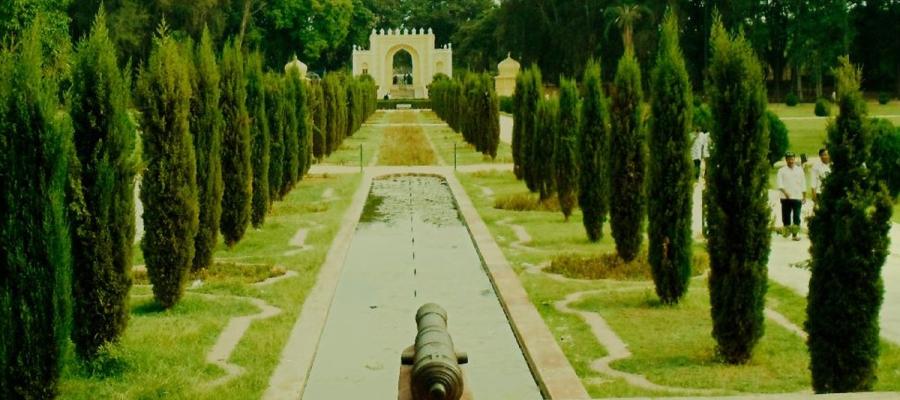
For history lovers and those who are curious about travelling to historical sites in India Tipu Sultan’s Summer Palace in Bengaluru and the Srirangapatna Fort remains as significant reminders of Mysore’s golden past. The palace, built primarily of teakwood, reflects Indo-Islamic architecture with elegantly carved pillars, ornate balconies, and vividly painted floral motifs. As you walk through its royal chambers, you can almost sense the strategic discussions and cultural richness that once filled these halls. The Srirangapatna Fort, where Tipu Sultan made his final stand, carries immense historical weight. Enveloped by the River Cauvery, the fort complex features age-old gateways, remains of battlements, armories, and spiritual spaces. Visiting these landmarks will offer a deep heartfelt connection to Tipu Sultan’s courage, vision, and steadfast resistance against colonial forces.
Karnataka is a treasure trove for heritage lovers and its historical tours beautifully narrate the story of Tipu Sultan and the Mysore kingdom. These crafted journeys often include visiting battlefields, palaces, forts, and museums that highlight Tipu sultan’s military advancement, governance, and cultural contributions. Guided tours offer context through storytelling, enabling travelers to know how Mysore evolved as a formidable power in South India. Each destination adds another layer to the region’s rich historical tapestry.
For travelers seeking a complete cultural engagement Mysore heritage packages offer a carefully curated experience. These packages meld history with local traditions, architecture, and cuisine, offering experience to visitors beyond historic landmarks and into the heart of Mysore’s legacy. From exploring Tipu Sultan’s sites and royal gardens to see the traditional art forms and festivals, the journey captivates the spirit of a kingdom that once confronted the dominance of the British Empire. It’s not just a tour—it’s a step back in time.
Keep reading Indian Panorama blogs and follow us on Instagram and Facebook for regular updates and beautiful pictures of India with soulful captions.
Travel with Indian Panorama. The most loved travel family and India’s Leading Destination Management Company.
Indian Panorama will help you choose destinations and our Travel Guides will guide you to experience a joyous journey throughout the vistas of India.
Mail: enquiries@indianpanorama.in
Phone: +91 431 4226122
For more details and bookings, feel free to visit, www.indianpanorama.in and get a free quote for your tour itineraries.
Share This News