



No.4, Annai Avenue, Vasanth Nagar EXTN,
Srirangam, Trichy, Tamil Nadu ,620006.
CIN: U31100TN2010PTC078389
DUNS Number: 859496557

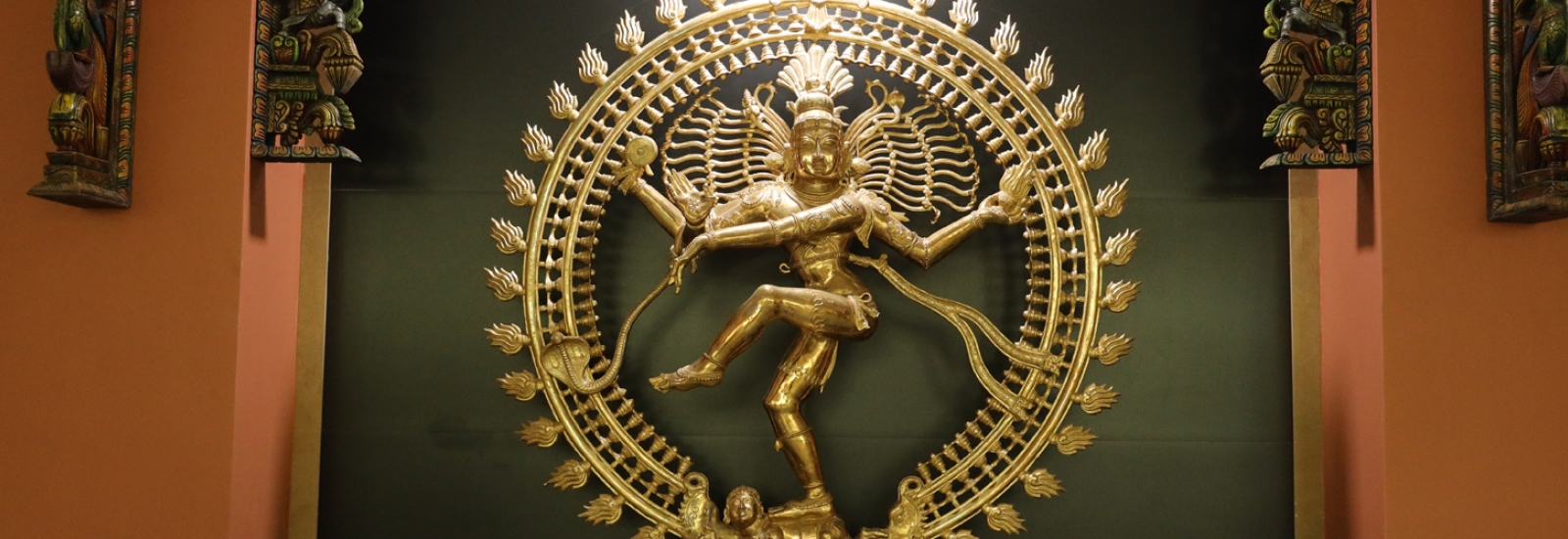
Across various centuries of Indian philosophy and spiritual art, few images have captivated the imagination of scholars, devotees, and scientists alike as distinctly as Lord Shiva Nataraja, the divine dancer who glides at the heart of the universe. The image of Shiva dancing within a ring of fire is not just a representation of devotion—it is a deep expression of universal rhythm, cosmic energy, and the everlasting cycle of creation and annihilation.
In the sculptures of the temple and in the sacred literature, the cosmic dance of Shiva has been understood as a symbol of how the cosmos functions. Age-old sages visualized existence as movement—vibration, transformation, and renewal. Today, contemporary science resounds this understanding, describing matter itself as powerful energy in motion. Upon the first glance, these worlds of mythology and physics may appear far apart, yet the representation of the lord Shiva nataraja connects them in remarkable ways. Even more captivating is how this symbolic form has earned global attention far beyond religious contexts. The presence of a shiva nataraja statue at one of the world’s most premier scientific institutions stands as a dynamic reminder that age-old insights can align with contemporary discoveries.
According to the Hindu philosophy, Lord Shiva Nataraja represents Lord Shiva in his most powerful and expressive form—the cosmic dancer who directs the rhythms of existence and time. The word “Nataraja” comes from Sanskrit: “Nata” means dance and raja means king. Together, the term signifies Lord Shiva as the King of Dance, a figure who embodies the pulse of the cosmos itself.
As per the sacred Hindu traditions, the divine dance performed by Shiva Nataraja is widely known as the “Ananda Tandava”, or the Dance of Bliss. This dance is believed to occur in the cosmic realm of consciousness, where energy and matter blend in harmony.
The artistic form of the lord Shiva Nataraja is teemed with elaborate symbolism. Shiva is often portrayed dancing encircled by flames standing on a miniature figure known as the Apasmara, who symbolize ignorance. One hand holds a drum representing creation, while another signifies fire, representing cosmic dissolution.
Historically, the image of Nataraja earned significance during the Chola dynasty of South India, where bronze sculptures of the dancing Shiva turned into a masterpieces of sacred art. These sculptures were not merely artistic accomplishments but also philosophical concepts capturing profound spiritual ideas in visual form. The nataraja shiva dance thus became a focal symbol of devotion, meditation, and intellectual contemplation.
Interpreting the cosmic dance of shiva meaning enables us to recognize how ancient thinkers envisioned the universe long before physics found its voice. For them, the dance was not merely symbolic; it served as a means to convey the dynamic nature of reality.
One of the most fascinating intersections between spirituality and science can be found at the headquarters of the European Organization for Nuclear Research, famously called as CERN, in Switzerland. At this renowned research center, where scientists explore the basic structure of matter, a spectacular Shiva Nataraja statue stands prominently in the courtyard.
The Government of India gifted the statue to CERN as a symbol of profound link between age-old Indian philosophy and contemporary physics. Scientists working at CERN analyse the behavior of subatomic particles—tiny building blocks that continuously shift, collide, and change. Interestingly, this enduring activity resembles the dynamic energy represented in the cosmic dance of Shiva.
Physicists learning particle motion often describe the as a dance of energy and matter. At the smallest scales, particles appear and disappear in fast cycles, similar to the processes of creation and annihilation symbolized by Lord Shiva Nataraja.
Other than symbolism, the installation of this sculpture mirror an increasing recognition that knowledge surpasses boundaries. Science seeks to measure and describe reality through empirical investigation, while spirituality and philosophy interpret the same reality through meaning and reflection. In this shared pursuit of truth, the lord shiva nataraja becomes a bridge linking ancient wisdom with contemporary study
At the heart of the cosmic dance of shiva lies the profound concept of continuous creation and destruction. In Hindu philosophy, these processes are not seen as opposing forces but as complementary aspects of the same cycle. The dance performed by Shiva Nataraja represents the universe in motion, where beginnings and endings are interconnected phases of transformation.
The rhythmic drum, known as the damaru, held by lord shiva nataraja, symbolizes the sound of creation. In physics, vibration is considered the foundation of matter and energy. Sound waves, electromagnetic waves, and quantum vibrations all demonstrate how movement generates form. The drumbeat of Shiva thus becomes a metaphor for the vibrations that initiate the birth of the universe.
Modern cosmology describes the universe as expanding since the moment of the Big Bang, a powerful event that marked the beginning of time and space. Yet scientists also theorize that the universe may eventually contract or transform into another state, continuing an endless cycle. This idea closely resembles the cyclical processes embodied in the nataraja shiva dance, where creation and dissolution occur simultaneously.
By exploring the cosmic dance of shiva meaning, we gain insight into how ancient thinkers interpreted universal processes long before telescopes and particle accelerators existed. Their symbolic language captured the essence of change, motion, and renewal—principles that modern science continues to study in greater detail.
The image of Shiva Nataraja is not merely a work of art—it is a meticulously constructed visual philosophy that holds a profound scientific and metaphysical ideas. Every element in the form of the dancing Shiva carries symbolic meaning that connects surprisingly good with principles observed in physics and nature.
At the heart of the image stands the dancing figure of Lord Shiva Nataraja, surrounded by a circular ring of flames called as the prabha mandala. This fiery circle symbolizes the universe itself—powerful, expanding, and steadily transforming. In modern cosmology, the cosmos is understood as a continuously changing system teemed with galaxies, stars, and space radiation.
In the upper left hand, Shiva bears a flame representing annihilation. However, this destruction is not a conclusion but an essential phase of renewal. Contemporary science shows that destruction often leads to creation. For example, when stars explode as supernovae, they emit elements that eventually form new stars and planets. The flame held by lord shiva nataraja beautifully represents this process of cosmic recycling.
Another significant feature is the raised foot of Shiva. It represents freedom and upliftment, suggesting the possibility of elevating above ignorance and limitations. Thinking scientifically this idea can be linked to growth and discovery. Humanity advances by eliminating ignorance through observation, thinking, and testing. Right below Lord Shiva’s feet lies the Apasmara, the dwarf representing ignorance. From a philosophical point of view, ignorance is seen as the biggest barrier to comprehend reality. Collectively, these symbolic components illustrate the profound cosmic dance of shiva meaning, presenting an integrated view of creation, preservation, and transformation.
Many ancient scriptures describe the universe as a rhythmic process governed by cycles of birth, growth, decay, and renewal. This cyclical view of reality aligns closely with modern scientific theories that describe the universe as dynamic rather than static. The imagery associated with Shiva Nataraja embodies this idea, portraying the universe as an ongoing process rather than a fixed structure. Another remarkable concept found in early Indian thought is the idea of time as cyclical. Rather than viewing time as linear, ancient thinkers described vast cycles known as yugas, during which the universe evolves and eventually dissolves before beginning anew.
The symbolic representation of the nataraja shiva dance reflects these cyclical processes. Every movement in the dance signifies change, transformation, and renewal. Just as particles collide and transform in high-energy experiments, the cosmic dancer moves through patterns that sustain the universe. These parallels do not suggest that ancient scholars practiced physics in the modern sense, but they demonstrate an intuitive understanding of natural laws. Through symbolic language and philosophical insight, they explored questions that scientists continue to investigate today. The enduring presence of the lord shiva nataraja as a cultural and philosophical symbol highlights how ancient wisdom can remain relevant even in the age of advanced technology.
Among the spiritual traditions linked with Shiva, the concept of the Pancha Bhoota temples has a special place. These five temples symbolize the basic elements of nature such as the earth, water, fire, air, and space. Each temple symbolizes one element, highlighting the belief that the universe is composed of interrelated forces. The Chidambaram temple in Tamil Nadu is correlated with the element of space, also called as the “Akasha” This temple is particularly important because it is believed to be the space where the cosmic dance of Shiva is unceasingly performed. Within its sacred halls, the dance of Shiva is renowned as a manifestation of the universe itself.
The Chidambaram temple is also popular for the concept of the “Chidambara Rahasyam,” or the secret of Chidambaram. This mystery represents the presence of the divine in the form of empty space, symbolizing the unseen forces that maintain existence. Within the temple complex, the image of Shiva Nataraja serves as a main focus of dedication and reflection. Devotees believe that watching the divine dance within this sacred space offers glimpse into the nature of reality itself. The temple thus becomes not only a place of worship but also a philosophical symbol of the universe’s hidden dimensions.
By connecting sacred architecture with basic principles, the Pancha Bhoota temples show how ancient cultures interpreted the world around them. The connection between space and consciousness mirrors a profound awareness of the subtle energies that shape existence, reaffirming the timeless relevance of the cosmic dance of shiva meaning.
In the period driven by technology and fast scientific advancement, historical symbols endure to demonstrate relevance in unexpected ways. The image of the lord shiva nataraja stays meaningful not merely to devotees but also to artists, thinkers and scientists who seek to comprehend the universe. One reason this symbolism continues is its timeless message about change. Contemporary life is defined by continuous transformation—technological advancement, technological progress, digital innovation, and evolving societies. The cosmic dance of Shiva bring to mind that change is a natural and essential part of existence. Rather than resisting transition it fosters acceptance of growth and renewal. Furthermore, the global recognition of the shiva nataraja statue as a symbol of cosmic movement highlights the power of cultural heritage. It shows how ancient knowledge can contribute to contemporary dialogue, connecting the gap between past and contemporary.
As one of India’s most spiritually important destinations, Chidambaram is not merely a home to a most revered temple but also to centuries of significant architecture, philosophy, sacred traditions, and scientific representation focused on the divine cosmic dancer.
A meticulously planned journey enables tourists completely appreciate the traditions pertaining to lord shiva nataraja and the profound importance of the eternal dance renowned within the temple’s sacred halls. From watching everyday rituals to comprehending the intricate architectural elements that mirror the universal principles, every experience turns richer when guided by professionals who are aware of the historical and cultural depth of the region.
This is where Indian Panorama stands out unique as a trusted name in handpicked travel experiences across India. With several years of expertise in arranging spiritual, heritage, and cultural tours, Indian Panorama assures that every aspect of your journey is expertly managed with care and precision. Our services include customized itinerary planning, convenient transportation, proficient local guides, and hassle-free travel arrangements that enable visitors to pay full attention to the cultural and spiritual and experience.
Travelers choosing Indian Panorama can also expand their visit beyond Chidambaram, discovering nearby heritage destinations, significant ancient temples, and culturally important landmarks. These well-structured tour packages offer a balanced meld of spirituality, history, and learning, helping visitors gain a profound understanding of the traditions connected with the cosmic dance of Shiva.


Share This News